
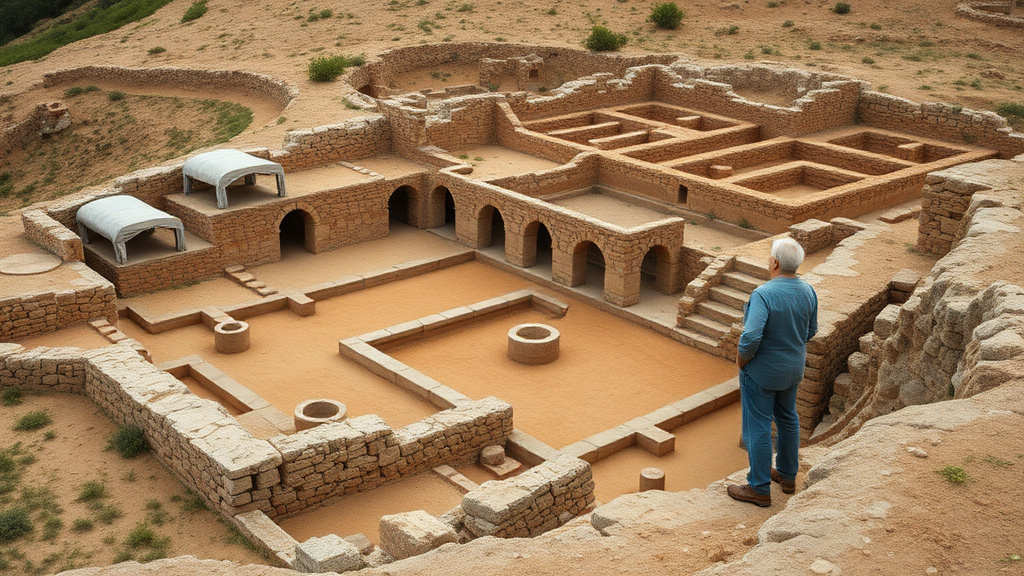
Revolutionary discoveries are transforming our understanding of ancient Rome. Using advanced ground penetrating radar technology, archaeologists have uncovered a remarkably preserved Roman settlement hidden beneath sediment layers for nearly 2,000 years. This groundbreaking technique allows researchers to peer underground without traditional excavation methods, revealing detailed insights of structures, artifacts, and daily life. Explore how this technological innovation is revolutionizing the field and what these extraordinary results reveal about ancient Roman society.
Groundbreaking Discovery Methods
GPR technology represents a paradigm shift in archaeological research. This non-invasive imaging technique employs electromagnetic waves to locate underground features without disturbing the soil. By analyzing how these waves bounce off buried structures and artifacts, researchers can produce comprehensive maps of subsurface configurations. This method proved essential at the Roman site, where GPR located building foundations, roads, and pottery concentrations with exceptional accuracy, allowing archaeologists to organize focused excavations systematically.
The strengths of GPR technology surpass mere convenience. Traditional excavation methods threaten to damage delicate artifacts and irreplaceable archaeological contexts. GPR surveys protect contextual integrity while offering extensive insights about spatial relationships and settlement organization. Furthermore, this technology accelerates the discovery process significantly, allowing researchers to cover vast areas efficiently. The Roman settlement’s successful identification demonstrates how modern technological innovation enhances our ability to unlock ancient secrets while respecting the sanctity of historical sites for future research and generations.
The Roman Colonial Findings
The excavation uncovered a detailed Roman settlement originating in the 2nd century CE, complete with residential structures, public buildings, and commercial establishments. The site covers approximately three hectares and shows sophisticated urban planning typical of provincial Roman towns. Ground penetrating radar identified numerous subsurface features, comprising foundations, roads, and underground storage facilities. The settlement’s layout indicates a thriving community with distinct residential and commercial zones, delivering invaluable insights into Roman provincial life and architectural practices throughout this flourishing time.
Physical Structures and Artifacts
Archaeologists uncovered exceptionally intact stone base structures belonging to approximately fifteen dwelling units, along with what seems to be a small forum and government structure. The structures display characteristic Roman construction techniques, such as Roman concrete and precisely laid stone slabs. Many items excavated at the site include ceramic pieces, coins, implements, and ornamental objects that shed light on routine practices and trading networks. These findings suggest the community sustained extensive commercial ties reaching across the Roman Empire, promoting exchange of goods and ideas throughout distant regions.
The artifact assemblage provides strong indicators of social stratification within the community, with luxury items suggesting wealthy inhabitants alongside practical everyday items associated with lower-class residents. Imported ceramics from the Mediterranean area demonstrate the settlement’s connection with the wider Roman trading system. Individual possessions such as jewelry, hairpins, and writing implements provide insight into personal existence and domestic practices. The range and volume of artifacts recovered underscore the settlement’s importance as a major commercial center sustaining varied communities and trading businesses.
Dating and Historical Relevance
Multiple dating techniques, including radiocarbon analysis and ceramic typology, verify the settlement thrived during the 2nd and 3rd centuries CE, a period of considerable Roman expansion in the region. This temporal sequence places the site within a pivotal era of territorial expansion and economic prosperity. The settlement’s founding coincides with substantial Roman infrastructure projects and military campaigns that secured control over frontier territories. Grasping this chronological context helps archaeologists reconstruct local historical accounts and understand how regional societies responded to Roman imperial rule and profited from incorporation into the wider empire.
The discovery holds substantial historical importance for scholars examining Roman provincial communities and patterns of urbanization. This site provides rare archaeological evidence of how Romans established and maintained communities in outlying areas, adapting their systems of architecture and administration to local conditions. The settlement’s apparent prosperity and longevity suggest effective assimilation with neighboring communities and efficient management of resources. These findings contribute meaningfully to wider conversations about Roman territorial growth, spread of culture, and the ways in which Rome maintained its extensive territorial control across centuries.
Ground Penetrating Radar Technology
GPR technology, often referred to as GPR, represents a revolutionary advancement in archaeological research. This non-destructive method employs electromagnetic waves to generate comprehensive underground imagery without disturbing the soil. By sending electromagnetic signals into the ground and analyzing their reflections, archaeologists can identify underground formations, artifacts, and geological features with remarkable precision. The technology has proven invaluable in uncovering the ancient Roman site, allowing researchers to document foundations, routes, and storage facilities prior to excavation work.
The benefits of GPR technology surpass simple detection capabilities. This method markedly decreases excavation costs while maintaining archaeological contexts that traditional digging might compromise or obliterate. The detailed three-dimensional maps generated by GPR enable archaeologists to create focused excavation strategies, concentrating resources on the most likely locations. Furthermore, the technology delivers complete visibility of entire settlements, uncovering spatial patterns and city design layouts that would otherwise lie buried beneath centuries of accumulated soil and debris.
- Electromagnetic waves pass through soil layers identifying buried structures
- Non-invasive method maintains archaeological context and integrity
- Creates detailed three-dimensional underground survey data
- Reduces excavation costs and time significantly
- Enables targeted research strategies for optimal results
